Showing posts with label John 1:1-18. Show all posts

Friday, January 8, 2016

John 1:14-18 Jesus is God


Introduction
 Here we are, at last, the final portion of John's prologue. We have walked through the Evangelist's introduction, seen that Jesus was God, was with God, created all things, and was the reasoning men needed to believe in Him. Now, John introduces his readers to something completely new. In another way, John threw a curve ball to his audience. He claimed something of Jesus that neither Jew nor Greek would have believed of the Logos. This was that Jesus, God, became flesh. That meant that God became both human and God at the same time. This is why John can say of the Logos, [n]o one has ever seen God; the only God, who is at the Father’s side, he has made him known. John tells us that Jesus is God and only He can make God, the invisible, known. 


And the Word Became Flesh...
To Hellenistic Greeks, the Logos was an abstract thought. Their gods could be seen in human form, but were never human. In a similar fashion, the Jewish understanding of God was that he was a spiritual being and, therefore, you did not worship any created thing. This verse is the key argument of the divinity and humanity of Jesus. The Gnostics misunderstood (still do to this day) this verse to mean that Jesus was divine while the later heresy of Arianism believed that Jesus was not divine, but human.

The Greek word for dwelt among us, which in the NRSV is lived among us and in the NIRV as made his home with us, was skenoo This word meant to tabernacle or to dwell. For John's readers, they would have seen this word skenoo and would have immediately understood the image of the OT Tabernacle in the Exodus period. For John's community, as well as for us today, Jesus was the NT version of the Tabernacle. Jesus was God's presence in human flesh among His people (Barton, et al., John, 12).

The word for glory in Greek is doxa. According to David Seal's article in the Faithlife Study Bible, "[d]oxa essentially describes manifestations of supernatural splendor or divine glory." It's used 42 times in the Gospels, which is translated differently in the many English versions of the Bible. For this context, glory is used in the NASB, NIV, KJV, ESV, and NLT. John's purpose for using doxa here is to get his audience to see Jesus as the visual and physical glorification of Yahweh just as He resided in the tabernacle in the days of Moses. Barton says it best: "Underneath Jesus' appearance as an ordinary Jewish carpenter, the disciples saw the indwelling glory of God" (Barton, et al., John, 12). 


John's Parenthetical Statement
In English grammar, a parenthetical statement is one that is inserted to explain something, yet it could be taken out of the prose without creating any confusion on the meaning. John's parenthetical, here, is simply to restate Jesus' eternal divinity (Barton, et al., John, 14). Some think that the insertion is justified with the following of verse 16. J. Ramsey Michaels believes this, making the Baptist the first actual messenger of Christianity, at least in John's community (Michaels, John, 23-24). John Barclay has verses 15-17 connected together (Barclay, John, 70-73). However, Malina and Rohrbaugh see this statement as a way of making Jesus better than John--e. g. "[t]he implied defensiveness on this topic may be an indication of rivalry between the disciples of Jesus and John" (Malina and Rohrbaugh, John, 33). Haenchen on the opposite end holds that these subordinations of the Baptist to Jesus was not due to any rivalry, but in fact showing the fulfilling of John's role as the one who proclaims Jesus' coming (Haenchen, John, 120). 


Grace Upon Grace...
Grace upon grace, in most English translations, sounds like John is saying grace added to grace. Yet, in the Greek it is read "grace in place of grace" (Barton, et al., John, 15; Barclay, John, 71). Grace is an important theological term in the New Testament. John is saying that in Christ's fullness we have grace, which could be interpreted as grace restoring grace (Barton, et al., John, 15). This is why John can say that "the law was given through Moses; grace and truth came through Jesus Christ." The Law introduced us to God's justice while Christ brought us God's grace (Barton, et al., John, 16). Christ is the New Covenant that God made with His people. 

When John says that "[n]o one has ever seen God" he does not mean a physical (there were 'theophanies' or special visions of God in person throughout the OT), but in a characteristic way (Barton, et al., John, 16). What is really being said here, is that Jesus is the only one able to show the true representation of God to His people. In fact, the Greek says that Jesus describes God (Barton, et al., John, 17). God is made clear through the knowledge of Christ. Jesus is God, and who better to explain God than God Himself. 

How did you interpret this portion of the text? How was this helpful for you? How did God speak to you in these last few posts? Leave your comments in the section below or questions if you have any. Thanks guys for reading and be blessed.

C. Bohall

Bibliography
Barclay, William. Gospel of John. vol. 1. Philadelphia: Westminster Press, 1975.

Barton, Bruce B. Philip W. Comfort, David R. Veerman, and Neil Wilson. John. 1993. 

Haenchen, Ernst. John 1. Trans. Robert W. Funk. Philadelphia: Fortress Press, 1984.

Malina, Bruce J. and Richard L. Rohrbaugh. Social-Science Commentary on the Gospel of  John. Minneapolis: Fortress Press, 1998. 

Michaels, J. Ramsey. John. Peabody: Hendrickson Press, 2005. 

Thursday, December 31, 2015

John 1:6-13 The Baptist and the True Light


John 1:6-13 ESV
There was a man sent from God, whose name was John. 7He came as a witness, to bear witness about the light, that all might believe through him. He was not the light, but came to bear witness about the light.
The true light, which gives light to everyone, was coming into the world. 10 He was in the world, and the world was made through him, yet the world did not know him. 11 He came to his own, and his own people did not receive him. 12 But to all who did receive him, who believed in his name, he gave the right to become children of God, 13 who were born, not of blood nor of the will of the flesh nor of the will of man, but of God.


There was a man sent from God...
Interestingly, John breaks up his prologue (some see this as a hymn) to introduce us to John the Baptist. He takes three sentences to explain that John was the witness to Jesus' coming. Why would John do that? Why break up the prologue, in the middle, just to introduce John as Jesus' witness only to pick up John's story at vs. 19? 

John was not the light, yet he came to give witness of the light. This is what the Evangelist (I am going to use this term to distinguish between John the Apostle and the Baptist) plans to do here. The Baptist is mentioned in all four Gospels: Matt. 3:1-6; Mark 1:1-6; and Luke 3:1-6. Later, in John's Gospel, the Evangelist talks in depth about the Baptist and his mission and message. What did it mean for John to be a witness, though? According to Malina and Rohrbaugh, to be a witness in John's day meant that you affirm one's honor (Malina and Rohrbaugh, John, 32). This testifying was also to be done publicly, out in the open for all to see. Now, we need to look at the meaning of light to understand what the Evangelist is saying.


The True Light...
John is telling us that Jesus is the very opposite of darkness, that Jesus is not just a/the light, but that He is the True Light. The word true in Greek is alethinos and means it is not just the name, but it is the description and meaning of the word it describes. Also, the word means the complete opposite of falsehood. So, here the John is telling us that the light is not just a metaphor for Jesus, but that he is the light. He is so much the light, that he is not the darkness. The word light in Greek is phos, which in this context is used of a metaphor for truth and reasoning. It harkens back to the use of the word logos which also meant reasoning. Which is what leads us into the next portion, that Jesus was rejected. Why would He, the basis of reasoning, be rejected? 

...The World did not Know Him...
What we have here, is John's explanation of the coming of the Messiah. In vs. 9, the Evangelist presents us with the truth that the Light has come (present tense) into the world. Here, we see the rejection of the coming Messiah. The world does not know Him, meaning that they do not have the reasoning needed to recognize the true Light. Barclay states that God's Logos has always been in the world and that man has always been able to see it (Barclay, John, 56-58 ). 

The Greek word here for know is ginosko, which means to know or get to know. Malina and Rohrbaugh tell us that John uses an OT understanding in his context of know--it was a very intimate way to know someone, "face to face" (Malina and Rohrbaugh, John, 32). Haenchen explains how God answers the willingness of the world to refuse to know its Creator--
"For the Logos did not give up in the face of this rejection. On the contrary, he now does the highest, the final, thing that was still possible: he becomes man himself, in order to be received by humankind" (Haenchen, John, 118). 
However, becoming flesh and blood was not good enough, because not only does the world not accept Him, neither does His very own possession--Israel. 

...His own did not Receive Him...
Israel, the place that redemptive history was to be brought did not receive their Lord. Michaels says that Israel and Judaism would be the place of Christ's ministry, yet the context of the word world might mean that the world was the main point of Christ's purpose of salvation (Michaels, John, 23). Either way, the point seems clear--Jesus was not accepted by either His own portion and the world as a whole. However, there are some who will accept Him. 

In the ancient world, a person's name meant something. Now, in America, we have meanings for our names, but the definition of our name does not define who we are. However, to people in the first century Palestine, their name defined them as a person. Here is how Malina and Rohrbaugh explain this phenomenon: 
First, it is the closest term for what we mean by 'person.' Since first-century Mediterranean persons were collective persons, their 'name' represents the entire family, along with the family's honor in the community (Malina and Rohrbaugh, John, 32).
This was what John means by believed in His name. Here we step into new life, we are literally adopted in Jesus' family. The notion here, in Greek, is the idea that God is giving us the right to be born again (Barton, et al., John, 9). John Calvin sees this verse as a grace of God. To Calvin, we do not have the choice, but were made to believe in God. However you see this, as a free-will choice or divinely appointed as Calvinists do is not important. What is, is that we are made children of God and welcomed into his family. Why is this important? Aside from the notions of being saved by Christ, it deals with the notion of the law at the time (by law, I actually mean Roman). In the Roman world, your bloodline was very important, it established your place in society. Mostly, the wealthy Romans are the ones who would be concerned with this law. Here is how it worked: Marriage was a big deal, the dowery was mostly land given to the newlyweds, who would have children to pass it on to. This was important because it kept the wealth that the land gave in the family. This was why being born of blood and of will by flesh was important to those in Palestine and in the Roman Empire, because of the way the marriage laws worked. Here, Jesus makes it possible to be born into His family easy, anyone is capable of becoming a child of God. His kingdom then becomes our inheritance. Jesus breaks the notion of human laws by saying that you can become an heir of His. We become a child of God and thus, are allowed access to his authority and protection. 

What did You Think?
Was this how you read the text? What thoughts did you glean from this? What did I miss? What was something new to you? Let me know in the comments section. Be blessed and leave me your thoughts; thanks, guys. 

C. Bohall
Bibliography
Barclay, William. Gospel of John. vol. 1. Philadelphia: Westminster Press, 1975.

Barton, Bruce B. Philip W. Comfort, David R. Veerman, and Neil Wilson. John. 1993. 

Calvin, John. "Commentary on John 1:1". "Calvin's Commentary on the Bible".    "http://www.studylight.org/commentaries/cal/view.cgi?bk=42&ch=1". 1840-57.

Haenchen, Ernst. John 1. Trans. Robert W. Funk. Philadelphia: Fortress Press, 1984.

Malina, Bruce J. and Richard L. Rohrbaugh. Social-Science Commentary on the Gospel of  John. Minneapolis: Fortress Press, 1998. 

Michaels, J. Ramsey. John. Peabody: Hendrickson Press, 2005. 


Friday, December 25, 2015

John 1:1-5 Jesus' Divinity Made Clear


John 1:1-5 NASB
1 In the beginning was the Word, and the Word was with God, and the Word was God. 2 He was in the beginning with God. 3 All things came into being through Him, and apart from Him nothing came into being that has come into being. 4 In Him was life, and the life was the Light of men. 5 The Light shines in the darkness, and the darkness did not comprehend it.

In the Beginning...
Every story has to start somewhere. For John, he takes it further than the other Gospel authors, it begins before everything. In Matthew, it starts with Abraham, Mark just passes it all and heads straight for the baptism, and Luke only goes as far back as Adam. Why does John go all the way back to before the beginning of everything? Who is this Jesus that John believes is before everything, ahead of even the universe? For John, the answer is simple--Jesus is the Word, the very being of God. Jesus is God; the Creator Yahweh. 

John is saying something very important with his statement that this Word is God. J. Ramsey Michaels believes that this is a cosmological statement, "[the] purpose of the Gospel writer is to place the story of Jesus in a cosmic perspective" (Michaels, John, 21). Most scholars agree that John is placing Jesus (John purposefully hides the identity of this Word as Jesus till the end of his prologue) as "the personification of God's creative word" (Michaels, John, 21). This is how I understand John's prologue. John tells us, in this order, that the Word was God, was with Him, created everything, life, light, and humanity of which who will not understand Him. This misunderstanding of the Word led to a rejection of Him. Yet, He also came to proclaim the Message of God.

It is very important that we remember that this prologue is meant to tie in with the first chapter of Genesis. By labeling Jesus as the Word, John is making a very significant point. John Shelby Sponge (I do not agree with everything from this man though he does make some good points from time to time) makes a statement, as he loosely translates Genesis 1 and 2: "In the beginning there was the oneness of God. Then out of God came God's word, 'Let there be light.' Now the singularity of God shared creation with a new power...the anonymous Jewish writers who wrote this creation story attributed  to the 'word' of enormous creative power, seeing it as separate from God, but God's very essence" (Spong, Fourth Gospel, 43). This statement is a good way to sum up John's use of the Word to mean this separate but equal essence of God, though I chose to say it this way so as not to mistake our Trinitarian orthodoxy with a weird pseudo-Arian misunderstanding: God was the Creator, Jesus, as God was the power as the Word, and the Holy Spirit as God was the action that made the creation. All three similar, one, and yet separate at the same time--the Three in One.
  
...was the Word...
The Word was God, His message, and the Messanger. The Word in Greek is logos and it has a lot of meanings packed into it. Basically, it meant logic, reasoning, a saying of or from the divine, doctrine, or discourse.  Interestingly, John might have written in Greek, and the audience may have been Hellenistic, is it possible that the logos might have a Semitic background to it? For Thomas Oden, it does. The main source, according to Oden, of the logos Christology of John is rooted in the ancient Hebrew phrase dabar Yahweh which means “Word of God” (Oden, Word of Life, 69). In the OT, logos is not only spoken, it is also “personified.” It is shown through the prophets (Isa. 55:10-11 and Jer. 1:4, 2:1) and as wisdom in the Proverbs (Prov. 8:22-30)--as well as in the Apocrypha (Oden, Word of Life, 69-70 and Barton, et al, John, 2-3). For Bruce Malina and Richard Rohrbaugh, the Logos is less Hellenistic and more socially Israelite. For them, the Logos is not an abstract theory of Reasoning but “self-revelation and self- communication” (Malina and Rohrbaugh, Gospel of John, 35-39). However, we must see this word as both Hebrew and Hellenistic in thought. 

 As mentioned earlier, the Greeks had several ways of using the word logos, in the first century. It could have been the thoughts of someone or their reasoning, or a person’s speech. In philosophy, it meant “the rational principle that governed the universe, even the creative energy that generated the universe” (Barton et al, John, 3). To the Greek's, logos was an abstract thought (Wright, John, 4). This abstract thought was the power to make a man choose right from wrong and gave order to the universe--it was the divinity of god in man (Barclay, John, 35). 

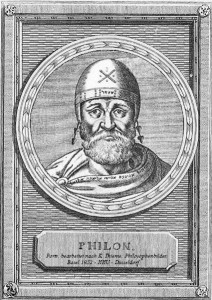
Philo of Alexandria

Philo of Alexandria took both the Hebrew understanding and the Greek belief of the logos and combined them. I believe that it is possible that John had copies, especially if he wrote this in Ephesus (which had a rather large library at one point), of Philo's works there. I think that John was influenced by Philo's logic of the logos and believed this to be the best way to understand Jesus and his relationship with God. Because of this, John could say that Jesus was the Logos, this reasoning of God, the divinity of God in man today, the one who helps us to make the right from wrong decisions. This is why John can say that Jesus is the life and the light. Through Jesus, we have the life of God that was given to Adam in the Garden, which he lost at the fall. The light that has been given is that which will guide us with reasoning. Jesus is the reasoning we must follow. Whatever Jesus did and said we are to do the same, Jesus only did as the Father told him to do. If we are followers of Jesus, then we are followers of God, and if we are followers of God, then we must do as we see and hear Jesus do, because he followed God. If you follow Jesus, then your life must show it.--Tweet that!

I hope to have the rest of John 1:1-18 up throughout this week. If I do not, then it will be up as I am able to post them. Thanks for reading; what do you find interesting about this text? What interpretations have you seen that I have not mentioned? Leave all your responses and comments in the comment section below. Thanks for reading and sharing, have a blessed day!

C. Bohall

Bibliography
Barclay, William. Gospel of John. Philadelphia: Westminster Press, 1975.

Barton, Bruce, Philip W. Comfort, David R. Veerman, and Neil Wilson. Life  
Application Bible Commentary: John. Carol Stream: Tyndal House Publishers, Inc.,  
1993.


Malina, Bruce J. and Richard L. Rohrbaugh. "Word." In Social Science  

Commentary on the Gospel of John. (35-39). Minneapolis: Fortress Press, 1998.


Michaels, J. Ramsey. New International Biblical Commentary: John. Peabody:  
Hendrickson Publishers, Inc., 1989.

Sponge, John Shelby. Fourth Gospel: Tales of a Jewish Mystic. New York: Harper Collins,  
2011.

Wright, Tom. John for Everyone: Part One. Louisville: Westminster John Knox Press, 
2004.